

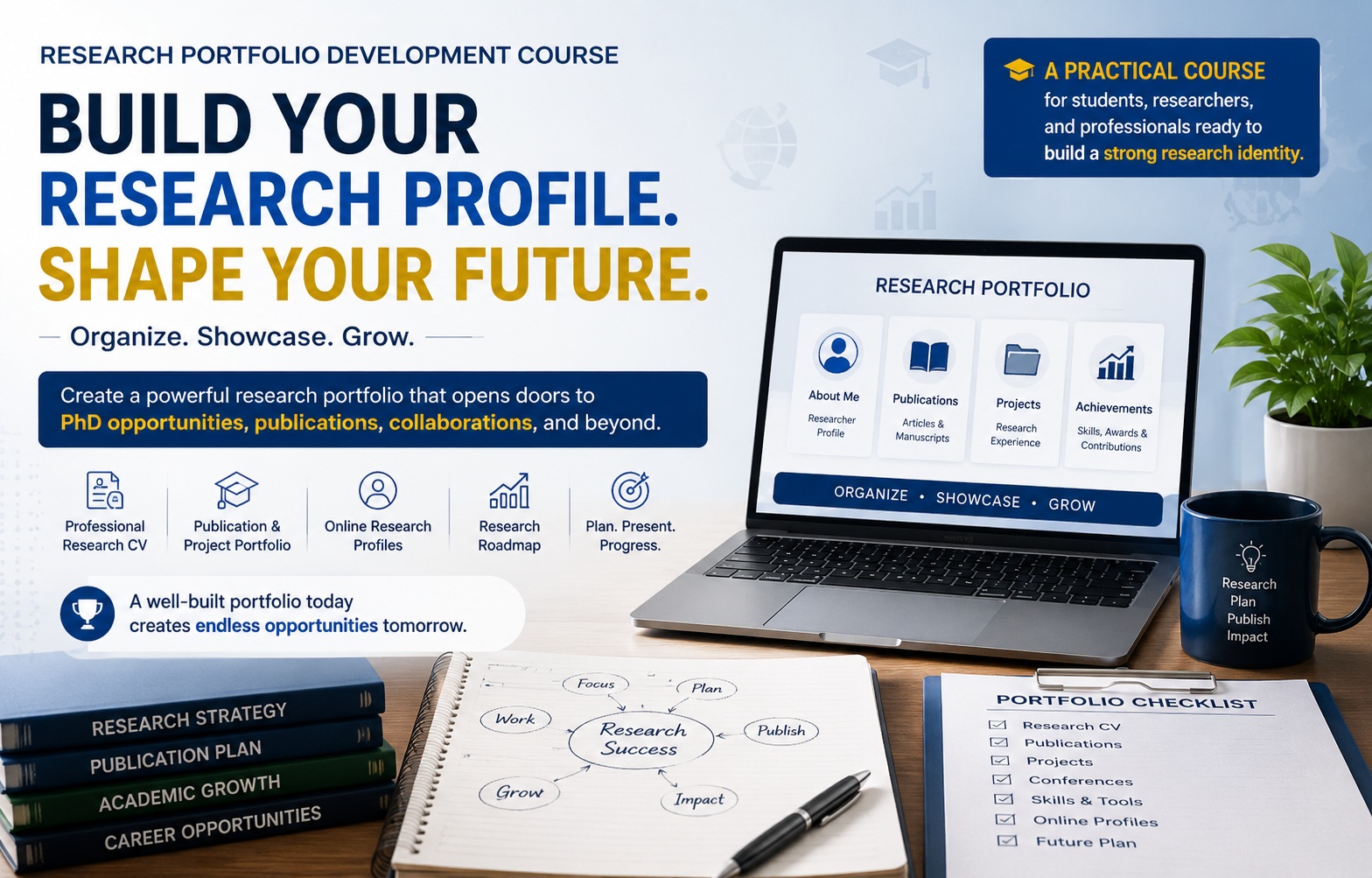
The Research Portfolio Development Course is a short and practical course designed for students, early researchers, professionals, and independent learners who want to organize their research achievements and build a strong academic or professional research profile.
This course teaches students how to create a structured research portfolio, organize publications and projects, prepare a professional research CV, set up research profiles, plan future publications, and present their research journey clearly.
The goal is simple: help students turn scattered academic work into a professional research portfolio.
Course Goal
By the end of this course, students will have a clear research profile and a practical portfolio roadmap that can support future academic, PhD, professional, publication, and long-term career goals.
Who This Course Is For
This course is suitable for:
- Undergraduate students
- Master’s students
- PhD applicants
- New researchers
- Independent researchers
- Working professionals
- Authors and publication beginners
- Students preparing for future research opportunities
- Professionals building a research-based profile
Course Duration
Suggested format: 4 to 6 weeks
Suggested sessions: 6 short modules
Course type: Live, recorded, one-on-one, or small group
Final output: Research Portfolio Packet
What Students Will Learn
Students will learn how to:
- Understand what a research portfolio is
- Identify their research strengths
- Organize publications, papers, projects, and achievements
- Build a professional research CV
- Write a short researcher biography
- Create or improve ORCID, Google Scholar, and LinkedIn research profiles
- Organize research evidence and documents
- Plan future research papers
- Build a publication roadmap
- Present their research journey professionally
Course Modules
Module 1: Research Portfolio Foundation
Purpose
Students learn what a research portfolio is and why it matters for academic, professional, and long-term profile development.
Topics Covered
- What is a research portfolio?
- Why students and professionals need a research portfolio
- Difference between resume, academic CV, and research portfolio
- What should be included in a portfolio
- How a portfolio supports PhD, publication, professional, and research goals
Student Activity
Students list their academic background, research interests, papers, projects, skills, and achievements.
Module Outcome
Students understand the purpose of a research portfolio and identify what materials they already have.
Module 2: Research Identity and Profile Building
Purpose
Students learn how to define their research identity and present themselves as emerging researchers.
Topics Covered
- How to define your research area
- How to write your research interest statement
- How to describe your academic and professional background
- How to write a short researcher biography
- How to present yourself professionally
Student Activity
Students create a short research identity statement and researcher bio.
Module Outcome
Students have a clear professional research identity and short biography.
Module 3: Academic CV and Achievement Organization
Purpose
Students learn how to organize their academic and research achievements into a clean CV format.
Topics Covered
- Academic CV structure
- Education section
- Research experience section
- Publications section
- Projects section
- Conference section
- Skills and tools section
- Awards, certifications, and professional activities
- How to avoid weak or confusing CV formatting
Student Activity
Students build or improve their academic/research CV.
Module Outcome
Students receive a structured research CV draft.
Module 4: Publication and Project Portfolio
Purpose
Students learn how to organize research papers, projects, manuscripts, datasets, presentations, and future publication plans.
Topics Covered
- How to organize published papers
- How to organize working papers
- How to describe research projects
- How to prepare a manuscript pipeline
- How to track journal submissions
- How to organize project evidence
- How to create a research project summary
Student Activity
Students create a publication and project tracking sheet.
Module Outcome
Students have a clear list of completed, ongoing, and planned research projects.
Module 5: Online Research Profiles
Purpose
Students learn how to create or improve their online research presence.
Topics Covered
- ORCID profile setup
- Google Scholar profile basics
- LinkedIn research profile improvement
- Personal website or portfolio page basics
- How to present publications online
- How to keep profiles consistent
- How to avoid exaggerated claims
Student Activity
Students update or prepare their research profile information.
Module Outcome
Students have a plan for building a clean and consistent online research presence.
Module 6: Research Roadmap and Final Portfolio Packet
Purpose
Students create a practical roadmap for future research growth.
Topics Covered
- Short-term research goals
- Long-term research goals
- Publication planning
- Conference planning
- Collaboration planning
- Skill development plan
- Monthly research activity tracker
- Final portfolio checklist
Student Activity
Students prepare a 3-month or 6-month research portfolio roadmap.
Module Outcome
Students complete a final research portfolio packet and future research plan.
Final Portfolio Deliverables
By the end of the course, students may receive or prepare:
- Research identity statement
- Short researcher biography
- Academic/research CV
- Research interest statement
- Publication list
- Project summary list
- Manuscript pipeline tracker
- Research achievement checklist
- ORCID / Google Scholar / LinkedIn profile plan
- 3-month or 6-month research roadmap
- Final research portfolio checklist
Result After the Course
After completing this course, students should be able to clearly explain:
- Who they are as a researcher
- What research areas they are interested in
- What projects or papers they have completed
- What research skills they are building
- What their future research plan looks like
- How their research profile can grow over time
Disclaimer
This course provides educational guidance, portfolio organization, academic CV support, research profile planning, and professional development support. It does not guarantee publication acceptance, PhD admission, citations, job offers, immigration approval, EB-1A approval, EB-2 NIW approval, or any specific academic, professional, or legal outcome.
Students are responsible for using the course materials honestly and following academic integrity rules. Immigration-related use of a research portfolio should be discussed with a licensed immigration attorney or authorized representative.
Important Disclaimer
This course provides educational guidance, portfolio organization, academic CV support, research profile planning, and professional development support. It does not guarantee publication acceptance, PhD admission, citations, job offers, immigration approval, EB-1A approval, EB-2 NIW approval, or any specific academic, professional, or legal outcome.
Students are responsible for using the course materials honestly and following academic integrity rules. Immigration-related use of a research portfolio should be discussed with a licensed immigration attorney or authorized representative.
What Students Will Learn
By the end of this bootcamp, students will learn how to:
- Understand what research is and how researchers think
- Start research from zero
- Choose a meaningful research topic
- Identify a research problem
- Develop research questions and objectives
- Search and organize academic literature
- Find research gaps
- Select an appropriate methodology
- Plan data collection
- Organize and interpret research findings
- Write a complete research paper
- Prepare a manuscript for journal submission
- Build a long-term research portfolio
- Continue working as an independent researcher
Course Curriculum
Module 1: Research Mindset and Foundation
Students learn what research is, why it matters, how researchers think, and how academic research creates knowledge, innovation, and professional value.
Topics covered:
- What is research?
- Why research matters
- Difference between research, report, article, essay, and thesis
- How researchers identify problems
- Research ethics and academic integrity
- How to think like an independent researcher
Outcome:
Students understand the basic mindset and structure of research.
Module 2: Research Topic Selection
Students learn how to find, narrow, and select a research topic based on interest, field, real-world problems, publication potential, and data availability.
Topics covered:
- How to generate research ideas
- How to narrow broad topics
- How to choose a publishable topic
- How to connect research with real-world problems
- How to create a research idea bank
- How to shortlist strong topics
Outcome:
Students create a list of possible research topics and select the most suitable direction.
Module 3: Research Problem, Questions, and Objectives
Students learn how to turn a topic into a clear research problem, research question, and objective.
Topics covered:
- Research problem development
- Research gap identification
- Research questions
- Research objectives
- Study scope
- Research contribution
Outcome:
Students prepare a clear research problem statement, research questions, and objectives.
Module 4: Literature Review and Research Gap Discovery
Students learn how to search, read, organize, and summarize academic papers.
Topics covered:
- How to search academic papers
- How to use Google Scholar and journal databases
- How to read papers efficiently
- How to summarize research articles
- How to create a literature review matrix
- How to find research gaps
- How to avoid plagiarism
Outcome:
Students build a literature review plan and organize sources for their research paper.
Module 5: Research Methodology and Research Design
Students learn how to select the correct research methodology based on topic, question, objective, and available data.
Topics covered:
- Qualitative research
- Quantitative research
- Mixed-method research
- Survey research
- Case study research
- Secondary data research
- Experimental research
- Research design
- Variables and measurement
- Sampling basics
- Validity and reliability
Outcome:
Students prepare a methodology framework for their research project.
Module 6: Data Collection and Data Organization
Students learn how to plan and organize research data.
Topics covered:
- Primary data vs. secondary data
- Survey design basics
- Public dataset use
- Data collection planning
- Data cleaning basics
- Variable organization
- Table preparation
- Ethical data handling
Outcome:
Students prepare a data collection plan, dataset structure, or data checklist.
Module 7: Basic Analysis and Result Presentation
Students learn how to organize research findings clearly.
Topics covered:
- Descriptive analysis
- Basic statistical thinking
- Tables and figures
- Result interpretation
- Connecting results with research questions
- Writing the results section
- Avoiding unsupported claims
Outcome:
Students learn how to present research results in a clear and professional way.
Module 8: Academic Research Writing
Students learn how to write a complete research manuscript.
Topics covered:
- Research title writing
- Abstract writing
- Introduction structure
- Literature review writing
- Methodology writing
- Results writing
- Discussion writing
- Conclusion writing
- Limitations and future research
- Keywords and highlights
Outcome:
Students prepare a structured research paper draft.
Module 9: Manuscript Development Workshop
Students work on actual research paper development under guided supervision.
Topics covered:
- Manuscript outline development
- Section-by-section writing plan
- Argument flow
- Citation placement
- Table and figure planning
- Revision planning
- Manuscript quality checklist
Outcome:
Students begin developing one or more research manuscript projects.
Module 10: Journal Selection and Publication Preparation
Students learn how to prepare a manuscript for journal submission.
Topics covered:
- How to choose a journal
- Journal scope review
- Avoiding unsuitable journals
- Formatting requirements
- Reference style
- Cover letter basics
- Submission checklist
- Revision and reviewer response basics
- Publication ethics
Outcome:
Students prepare a journal target list and publication readiness checklist.
Module 11: Research Portfolio Development
Students learn how to build a long-term research profile.
Topics covered:
- Research portfolio planning
- ORCID profile basics
- Google Scholar profile basics
- Conference strategy
- Collaboration planning
- Citation-building mindset
- Reviewer pathway basics
- Research documentation for academic and professional growth
Outcome:
Students prepare a personal research portfolio roadmap.
Module 12: Final Research Roadmap and Next Steps
Students receive guidance on how to continue research independently after the bootcamp.
Topics covered:
- Long-term research planning
- Monthly research goals
- Paper pipeline planning
- Publication tracking
- Collaboration strategy
- Next research project planning
- Independent researcher roadmap
Outcome:
Students leave with a clear research roadmap and next-step plan.
Hands-On Paper Development Model
This bootcamp may include guided development of research papers.
Depending on the selected package, we may work together on:
- 1 research paper
- 2–3 research papers
- 4–5 research papers
- A larger research portfolio
- Up to a maximum of 10 manuscript projects
The exact number of papers will be confirmed after reviewing the student’s goal, field, available data, topic complexity, timeline, and required support.
Bootcamp Packages
1. Starter Research Bootcamp
Best for beginners who are keen to learn research methodology and build their first research paper.
Includes:
- Research foundation training
- Topic selection support
- Research problem development
- Literature review planning
- Methodology framework
- One research paper development pathway
2. Research Writing Bootcamp
Best for students who already have a topic and want to develop a full manuscript.
Includes:
- Manuscript structure
- Literature organization
- Methodology writing
- Results organization
- Research writing support
- Journal preparation checklist
3. Publication Preparation Bootcamp
Best for students or professionals who already have a draft and need help preparing it for submission.
Includes:
- Manuscript review
- Journal selection support
- Formatting checklist
- Reference organization
- Cover letter preparation guidance
- Submission readiness checklist
4. Research Portfolio Bootcamp
Best for students, professionals, and future researchers who want to build multiple research projects over time.
Includes:
- Multiple research topic planning
- Research paper pipeline development
- Literature review system
- Methodology planning
- Manuscript development support
- Publication strategy
- Research profile roadmap
- Up to 10 manuscript projects depending on scope and readiness
Possible Deliverables
Depending on the package, students may receive the following:
- Research topic list
- Research problem statement
- Research questions and objectives
- Literature review matrix
- Research gap summary
- Methodology framework
- Data collection checklist
- Research paper outline
- Manuscript draft support
- Tables and figure planning
- Journal target list
- Submission checklist
- Research portfolio roadmap
- Publication preparation plan
Who Should Join
This bootcamp is suitable for:
- Undergraduate students
- Master’s students
- PhD applicants
- Working professionals
- Independent researchers
- Future authors
- Professionals building a research portfolio
- Individuals preparing for academic, professional, or long-term career development
Final Outcome
By the end of the bootcamp, students will understand how research works, how to plan a research project, how to write a research paper, and how to continue building a long-term research profile.
The goal is not only to complete research papers but also to help students become independent researchers who can think, plan, write, and publish with confidence.
Important Disclaimer
This bootcamp provides education, mentoring, research planning, writing guidance, editing support, and publication preparation support. It does not guarantee grades, journal acceptance, publication approval, citations, PhD admission, immigration approval, EB-1A approval, EB-2 NIW approval, or any specific academic, professional, or legal outcome.
Students are responsible for following their institution’s academic integrity policies. We do not fabricate data, create false evidence, write dishonest academic work, or provide legal advice. Students should discuss immigration-related profile use with a licensed immigration attorney or authorized representative.